Article: What Airline Handling Really Does to Your Luggage
What Airline Handling Really Does to Your Luggage

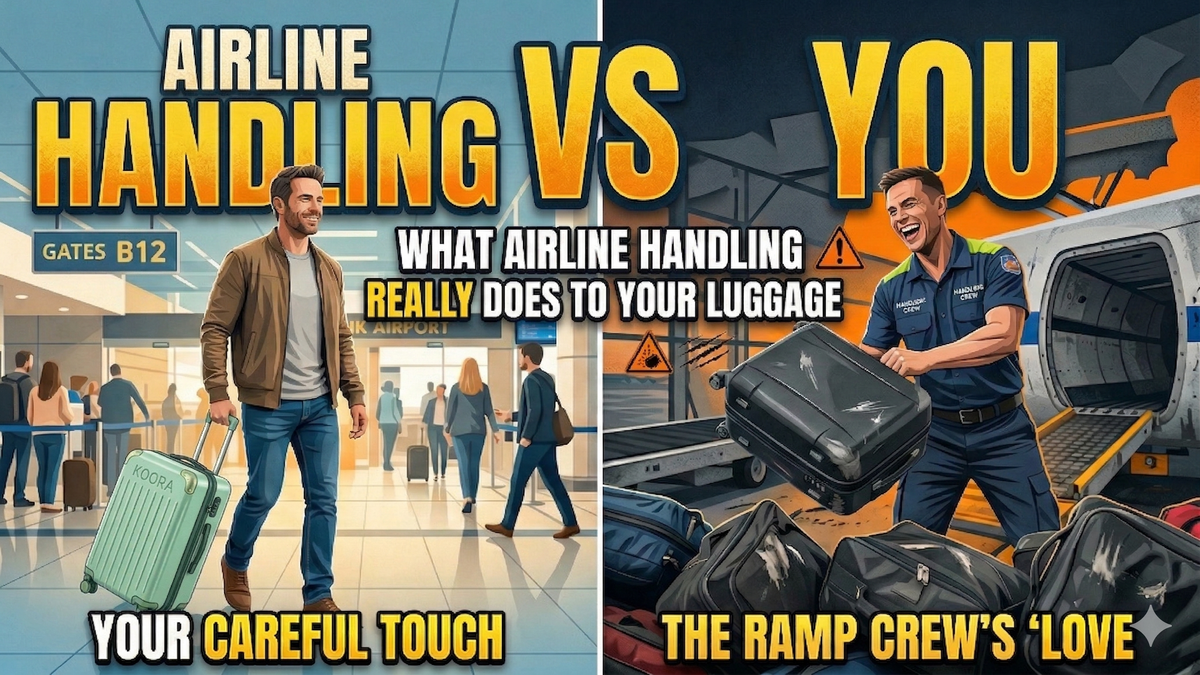
Most travelers imagine their suitcase taking a calm, linear journey: check-in → plane → baggage belt. In reality, your bag goes through a fast, mechanical obstacle course built for speed and throughput, not gentleness. It’s pushed, diverted, scanned, stacked, squeezed into tight spaces, rolled across rough surfaces, and handled under time pressure—often in rain, heat, or cold.
If you’ve ever wondered why a wheel suddenly wobbles, why corners scuff so aggressively, why a shell cracks “out of nowhere,” or why a zipper fails after a few trips, airline handling is usually the missing piece of the puzzle.
This article breaks down what checked baggage handling actually looks like behind the scenes, what forces your luggage experiences at each stage, why certain damage patterns are so common, and how to choose (and pack) a suitcase that survives real travel.
The hidden journey your luggage takes
When you check a bag, you hand it over to a system designed to move thousands of bags per hour. Airport baggage handling systems are essentially huge conveyor networks with junctions, diverters, and automated decision points that push bags onto different belts depending on destination and flight.
Your luggage typically goes through these stages:
1) Check-in: tagging and tracking begins
At check-in, your bag gets a tag (barcode and increasingly RFID depending on airline/airport). Airlines have been pushed to improve tracking visibility end-to-end—IATA Resolution 753 requires tracking at four key points: acceptance, loading, transfer, and arrival.
What can happen here
- Bag is dropped onto a belt with a short “thud” (small impact, repeated over time).
- Tag gets bent or partially torn if the strap snags.
2) Conveyor belts, junctions, and diverters
From check-in, bags enter the conveyor maze. At junctions, a mechanism may push or divert the bag onto a new belt to route it correctly. This is efficient—but it’s also where bags get side-loaded, nudged, and occasionally jammed.
What can happen here
- Abrasion against belt edges and guides.
- Hard corners take repeated micro-impacts.
- Protruding straps, loose tags, or dangling accessories can snag.
3) Security screening (this is not gentle)
Before loading, checked baggage is screened for explosives. TSA describes in-line systems and its Electronic Baggage Screening Program as ensuring all checked bags are screened.
And yes—bags can be opened. TSA explicitly notes that it may inspect checked baggage during screening and if a bag is locked and cannot be opened, locks may have to be cut.
What can happen here
- Your bag is diverted for additional screening.
- Bags may be opened and re-packed (not always as neatly as you packed them).
- Non–TSA-accessible locks can be cut if inspection is needed.
4) Sortation and the “make-up” area (where bags wait to be loaded)
After screening and sorting, bags arrive at a collection zone (often called make-up), where they’re gathered in chutes or on belts/carousels before being loaded into carts or containers and taken to the aircraft.
What can happen here
- Bags stack on top of each other.
- Heavy bags compress lighter bags.
- Corners and wheel housings get pressure points.
5) Ramp handling: carts, containers, and time pressure
Now your bag leaves the conveyor world and enters ramp reality: weather, vehicles, and tight turnarounds. Some aircraft load bags loose into the hold; others use Unit Load Devices (ULDs)—containers for baggage/cargo secured in the aircraft hold.
What can happen here
- Bags get stacked (compression) to maximize space.
- They can be bumped by carts, belt loaders, or container edges.
- Rain exposure on the apron/tarmac becomes real.
6) Flight environment: pressure, temperature, and vibration
Passenger aircraft cargo holds are typically pressurized (especially on larger aircraft), and may be climate-controlled to a degree—but they’re not uniform, cozy closets. One reason airlines and cargo operators use specialized temperature-controlled containers is precisely because hold conditions can vary.
What can happen here
- Cold can make some plastics less forgiving (more brittle).
- Vibration and repeated movement can loosen screws in wheel assemblies over time.
- Internal shifting (if you packed loosely) creates more stress on corners and shells.
7) Arrival: unloading, conveyors again, and the baggage carousel
On arrival, the process reverses—bags are offloaded (sometimes from ULDs), moved back onto conveyors, and delivered to the carousel. Baggage systems move fast, and when flights arrive in waves, bags can bump and pile at bottlenecks.
What can happen here
- Fresh scuffs and scratches.
- Wheel housings take hits when bags land hard.
- Handles can get caught if they protrude.
The real forces your luggage experiences
Airline handling damage is rarely “one big event.” It’s usually repeated stress plus one unlucky moment. These are the main forces:
Impact and drops
Bags get dropped short distances repeatedly: onto belts, off belts, into carts, out of carts. Corners and wheel areas absorb the worst of it because that’s where impact concentrates.
Compression and stacking
Your bag is not always riding solo. It can be stacked under heavier luggage, especially during peak loads. That creates long-duration pressure that can deform shells, crush corners, and strain zipper tracks.
Abrasion and scuffing
Conveyors, chutes, carts, and carousels all create friction points. Scuffs are normal. Deep scratches usually come from hard contact with metal edges, fast-moving belt transitions, or rough handling surfaces.
Snagging and tearing
Anything that sticks out can catch: loose straps, name tags, dangling locks, or overstuffed external pockets. This is where soft luggage can tear and zippers can fail.
Water exposure
Even if the aircraft hold is protected, the ramp isn’t. Bags can sit on carts in rain before loading. That’s why travelers often observe soft-sided luggage getting wet through, while hard-shell bags resist water better (though seams and zippers can still leak).
Human time pressure
Even with automation, humans are involved—and they work under turn-time pressure. That pressure increases the chance of rough stacking, quick tosses, and accidental drops.
Why specific luggage parts fail first
From real-world traveler discussions (and a lot of bitter experience), the same failure points repeat. Here’s why.
1) Wheels: the most abused component
Wheels take constant shock loads: curbs, cracks, belt edges, trolley impacts. In checked baggage handling, wheels can also be hit sideways when bags shift or get stacked.
What “durable” wheels usually imply
- Strong wheel housings
- Wheels that roll smoothly under load
- Better bearings
- Ideally, replaceable wheel modules (so one failure doesn’t kill the bag)
2) Telescopic handles: wobble and jam risks
Handles aren’t just pulled—they’re also pushed, bumped, and sometimes loaded sideways in carts. Over time, small misalignments become wobble, and wobble becomes breakage.
What to look for
- Minimal wobble at full extension
- Solid locking points
- Strong attachment to the frame, not just the shell
3) Zippers: the silent failure point
Zippers fail when:
- the bag is overstuffed (constant outward pressure)
- external pockets are packed bulky (snag risk)
- zipper coils are thin or low quality
- the bag is compressed under heavier luggage
Practical takeaway
A “premium” suitcase with weak zippers is not premium. For soft-sided luggage especially, zipper quality is a top-tier durability factor.
4) Shell cracking vs shell scuffing
Scuffing is normal. Cracking is a material/design problem plus impact. Lower-end plastics (often ABS) tend to crack more easily than high-quality polycarbonate blends; even good shells can crack if corner reinforcement is weak and the bag takes a hard corner hit repeatedly.
5) Locks and inspections
Security screening can require opening bags. TSA notes that if checked baggage is locked and can’t be opened through other means, locks may have to be cut.
That’s one reason TSA-accessible locking systems and TSA-approved locks exist—so inspections can happen without destroying the lock (though nothing is 100% guaranteed).
How to choose luggage that survives airline handling
If you want fewer “mystery damages,” choose luggage like you’re buying equipment, not décor.
A) Pick construction that matches your usage
- Frequent checking? Prioritize reinforced corners, strong wheel housings, and repairability.
- Mostly carry-on? Prioritize weight, overhead-bin compliance, and stability.
IATA notes carry-on rules vary by airline and aircraft, but many use a general reference around 56 × 45 × 25 cm including wheels/handles, and some impose weight limits starting around 5 kg.
B) Choose materials for impact behavior, not just looks
- If you go hardshell: look for high-quality polycarbonate, corner reinforcement, and robust wheel housings.
- If you go softside: look for strong fabric, reinforced seams, and excellent zippers.
C) Prioritize “stress parts” first
If you only inspect three things before buying luggage, inspect:
- wheels
- handle stability
- zipper quality (and zipper protection)
Everything else is secondary.
D) Avoid snag magnets
Minimize:
- dangling straps
- bulky external pockets (especially for checked luggage)
- accessories that can catch on belts and chutes
How to pack so airline handling does less damage
Even the best suitcase can fail faster if packed badly.
1) Support the structure from the inside
A half-empty checked bag collapses and deforms more under stacking. Fill space with soft items so the case holds its shape.
2) Put hard/heavy items in the center
Shoes, chargers, toiletry bottles, and heavy items should be centered and padded with clothing. This reduces corner stress and shell dents.
3) Don’t overstuff external pockets
External pockets are great for carry-on convenience, but on checked baggage they can snag and stress zippers.
4) Protect fragile items like you expect drops
Because drops happen. Use rigid protection (hard cases inside, bubble wrap, or thick clothing padding).
5) Liquids: double-bag them
Leaks are common. Pressure changes and rough handling can open caps. Use sealed pouches.
6) Remove old tags and loose straps
Old tags confuse humans and occasionally machines; loose straps snag.
How to reduce loss, delays, and transfer chaos
Airline handling isn’t only about damage. It’s also about missed connections and mishandling.
IATA’s baggage tracking work (Resolution 753) focuses on tracking bags at key journey points, and industry reporting notes the mishandled bag rate has improved over time, with many mishandled bags returned within 48 hours.
Practical ways to reduce risk:
- Prefer direct flights when possible.
- If connecting, avoid ultra-tight connections.
- Use airline apps and bag tracking where available.
- Add clear internal ID (name/email/phone) in case the outer tag is damaged.
If your luggage is damaged: what to do immediately
This part saves people real money.
1) Report damage before you leave the airport
Go straight to the airline baggage service desk when you see damage. Take photos on the spot.
2) Keep everything
Boarding pass, bag tag stub, claim paperwork, photos, receipts (especially if you need emergency replacement items due to delay).
3) Know the liability framework
For most international flights, liability is governed by the Montreal Convention framework. ICAO announced that the baggage liability limit for destruction/loss/damage/delay increased from 1,288 SDRs to 1,519 SDRs.
For U.S. domestic flights, the U.S. DOT states a maximum liability amount of $4,700 per passenger (airlines may pay more, but aren’t required to).
If you’re carrying very high-value items, consider:
- not checking them at all, or
- travel insurance / declared value options (where available)
Bottom line: your luggage is “handled,” not “carried”
Airline baggage systems are industrial logistics machines. Your suitcase will be diverted by pushers, scanned by security systems, stacked in make-up areas, loaded into carts or containers, exposed to ramp weather, and moved under turn-time pressure.
So when you choose luggage, choose it like something that will be stress-tested. The best suitcases aren’t the ones that look premium in a photo. They’re the ones that:
- roll smoothly for years,
- keep wheels and handles intact,
- protect zippers from overload,
- resist corner damage,
- and stay functional after the messy reality of airline handling.
Quick FAQ
Does hard-shell luggage protect better?
It can protect against moisture and crushing pressure, but shells can crack under corner impacts if the material/corner reinforcement is weak.
Why do wheels break so often?
They absorb shock constantly and get hit sideways during stacking and conveyor transitions. Wheel housings matter as much as wheel smoothness.
Can TSA open my checked bag?
Yes. TSA may inspect checked baggage, and if a bag is locked and cannot be opened, locks may have to be cut.
How can I reduce mishandling?
Direct flights, longer connection buffers, clear identification, and using airline tracking tools when available (Resolution 753 tracking points).