How to Choose the Best Carry-On Luggage for International Travel
 If you have ever stood at the gate wondering whether your bag will fit, rolled across a broken sidewalk while one wheel fought you, or tried to force a rigid suitcase into a crowded overhead bin, you already know something important: choosing the best carry-on luggage for international travel is not about picking the prettiest suitcase. It is about choosing a bag that works under pressure.
That is exactly where many travelers get it wrong. They focus on color, branding, or a polished product page, then discover the real problems later: the handle starts wobbling, the zipper feels strained, the bag is heavier than expected before packing even begins, or the “perfect” cabin bag suddenly does not look so perfect when an airline enforces a stricter size or weight rule. Carry-on baggage allowances really do vary by airline, cabin, and aircraft, though IATA notes that many airlines use a general reference around 56 × 45 × 25 cm, including wheels and handles, while some airlines apply stricter dimensions and weight limits. (IATA)
If you want an airline-friendly carry-on, a lightweight carry-on luggage option that still feels durable, and a premium carry-on luggage experience that is actually worth the money, you need to think like a real traveler, not a catalog shopper. Across the Reddit threads you shared, the same concerns kept repeating: wheel quality, overhead-bin fit, durability, weight, handle strength, zipper reliability, and whether a premium bag truly holds up over time. (Reddit)
Start with airline reality, not wishful thinking

The first step in choosing the best cabin luggage is accepting that “carry-on size” is not one universal standard. Many full-service airlines are reasonably generous, but international travel often means multiple carriers, smaller aircraft, and stricter enforcement. A bag that glides through one route may attract attention on another. Even official examples show how much variation exists: IATA gives a broad general reference, Air India lists 55 × 40 × 20 cm for cabin baggage, and IndiGo allows one cabin bag up to 7 kg and 115 cm total dimensions. (IATA)
This is why a smart traveler does not ask only, “Is this a carry-on suitcase?” The better question is, “Is this an overhead bin carry-on that works across the kinds of airlines I actually use?” If you travel domestically and internationally, or mix premium and budget carriers, the safest move is to choose a carry-on that stays comfortably within common cabin limits rather than flirting with the upper edge. That one decision alone reduces gate-check stress dramatically.
In practical terms, the best carry-on luggage for international travel is often not the biggest one marketed as a carry-on. It is the one that gives you the best chance of clearing different airline rules without drama.
Weight matters more than most travelers think
One of the clearest patterns in the Reddit conversations was this: people regret heavy luggage. They may forgive a bag for being plain, but they do not forgive it for being heavy before they have packed a single shirt. In one of the carry-on threads, users explicitly called out bag weight as something buyers should check carefully before anything else. (Reddit)
That makes sense. A heavy suitcase quietly steals packing freedom. On airlines that enforce weight limits, every extra kilo in the shell, frame, and handles becomes a problem for you later. Even where weight is not checked aggressively, a lighter case is easier to lift into overhead bins, easier to maneuver through airports, and easier to handle on stairs, curbs, trains, and hotel lobbies.

But there is a trap here. People often confuse lightweight carry-on luggage with flimsy luggage. They are not the same thing. A good carry-on should feel light in the hand without feeling fragile in the structure. If the shell feels paper-thin, the frame flexes too much, or the telescopic handle rattles before the bag has even been used, that is not smart lightweight design. That is just cost-cutting.
The sweet spot is simple: light enough to preserve packing capacity, solid enough to survive real travel.
Hard shell vs soft shell is not just a style choice
This is one of the most searched and argued-over luggage questions for a reason. Many buyers assume hard shell automatically means more premium, and soft shell automatically means less modern. Real travel is not that simple.
In the Reddit threads, some travelers strongly preferred soft-sided carry-on luggage because it gives a little flex in crowded overhead bins, offers easier-access exterior pockets, and can be more practical in tight hotel rooms or during the flight itself. Others still liked hard shell cases for structure and a more polished look. (Reddit)

So which is better?
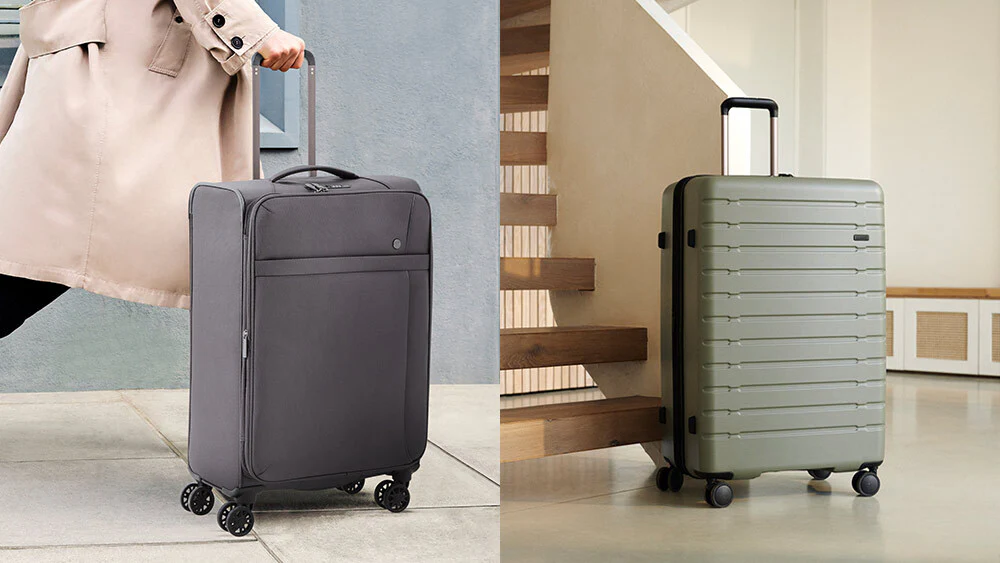
A hard shell carry-on can be great if you like a sleek, structured shape and tend to pack in a neat, organized way. It often looks cleaner and more premium. But if the shell is too rigid, it becomes less forgiving in overhead bins and can feel awkward when every inch matters.
A soft shell carry-on can be brilliant for travelers who want flexibility, quick-access pockets, and a more forgiving fit in tight spaces. It also tends to be practical for work trips, mixed-use packing, and situations where you may want to grab documents, chargers, or a sweater mid-journey.
The real answer is not “hard shell is better” or “soft shell is better.” The real answer is: choose the construction that matches how you travel. If you value flexibility and access, soft shell can be excellent. If you want a clean, structured premium look, hard shell can work beautifully. The best carry-on suitcase is the one that supports your behavior, not the one that wins on social media.
Wheel quality is one of the biggest deal-breakers
If there was one recurring complaint across the threads, it was wheels. Wheels breaking, wheels sticking, wheels wobbling, wheels failing at the worst possible time. One commenter even said buyers should look for bags where the wheels can be replaced because wheels tend to fail when you least want them to. (Reddit)
That should tell you something. Travelers are not obsessing over wheels because they are nitpicking. They are obsessing because bad wheels ruin the entire experience of using a suitcase. A bag can look premium, but if it drags badly, tips easily, or catches on rough surfaces, it stops feeling premium immediately.

When you evaluate durable carry-on luggage, pay close attention to:
-
how smoothly the wheels roll
-
whether the bag tracks straight
-
whether it feels stable when packed
-
whether the wheel housing looks robust
-
whether replacement or repair is possible
Do not underestimate this. A carry-on lives on airport floors, sidewalks, hotel corridors, parking lots, train platforms, and sometimes uneven streets. In real life, wheel quality often matters more than one extra organizer pocket or one more slick marketing feature.
Handles, zippers, and small failures become big frustrations
A lot of luggage disappointment comes from the parts buyers barely think about at first: telescopic handles, top handles, side handles, and zippers. But these are exactly the components that get stressed again and again.
In the Reddit discussions, travelers mentioned wobbling handles, zippers failing, cracked shells, and the difference between a bag that simply lasts and one that starts becoming annoying after repeated use. Repairability also came up as part of what makes luggage worth buying for the long run. (Reddit)
A good carry-on should have a telescopic handle that locks cleanly, feels stable at full extension, and does not introduce a cheap rattling sensation. The zippers should glide smoothly and feel strong, especially if the bag is marketed as expandable. If a zipper looks thin or strained on a new display model, imagine what it will feel like after months of overpacking.
This is where “premium” should actually mean something. Premium carry-on luggage is not just about polished branding or elegant colors. It should show up in the hardware, in the feel of the handle, in the confidence of the zipper, and in the bag’s ability to stay dependable after repeated trips.
A truly airline-friendly carry-on is easy to lift, easy to fit, and easy to live with
A lot of people think an airline-friendly carry-on simply means “small enough.” That is only part of it.
A truly airline-friendly carry-on should also be:
-
easy to lift into the overhead bin
-
balanced enough not to tip awkwardly
-
shaped well enough to slide into tight spaces
-
practical enough to pack for a short international trip
-
comfortable to maneuver through crowded airports
One of the Reddit comments summed up real-life priorities beautifully: the user kept a carry-on for years mainly because nothing had broken, it fit overhead bins, and it rolled straight. That sounds almost too simple, but that is exactly the point. (Reddit)
The best carry-on luggage for international travel is not trying to impress strangers. It is trying to remove friction from the journey.
Think about your trip type, not just your suitcase type
Another mistake buyers make is choosing luggage in the abstract. But a carry-on should match your actual trip profile.
For example, if your typical trip is three to five days, frequent airport movement, and mostly hotels, then a streamlined carry-on luggage recommendation should prioritize ease, speed, and organization. If your travel includes trains, cobblestones, mixed transport, or smaller accommodations, flexibility and compactness matter more. If you travel for work and personal trips both, you may want a carry-on that blends a polished appearance with practical internal organization.
The Reddit threads reflected this reality again and again. Frequent flyers valued durability and long-term reliability. More casual travelers often cared most about weight, ease of use, and not overspending. Some wanted lifetime warranties; others cared more about whether the bag could survive rough handling without becoming a headache. (Reddit)
That means the right bag is not just “the best one.” It is the best one for your pattern of travel.
Is premium carry-on luggage worth it?
Sometimes yes. Sometimes absolutely not.
A more expensive bag is worth it when the extra money buys better engineering, better materials, smoother mobility, stronger repair support, or a longer useful life. It is not worth it when you are paying mainly for status signaling.
This nuance showed up clearly in the Reddit threads. Some users strongly backed premium brands because of durability and years of travel use, while others pointed out that warranty language can sound stronger than the real replacement experience feels in practice. In other words, even a “lifetime warranty” is not enough on its own; the real question is how easy and fair the support feels when something actually goes wrong. (Reddit)
That is a very useful lens for shoppers. If you are considering premium carry-on luggage, ask:
-
Does it feel noticeably better built?
-
Are the wheels and handles genuinely strong?
-
Is the size sensible for international travel?
-
Is the warranty practical, not just impressive on paper?
-
Will this bag still make sense after dozens of trips, not just one?
If the answer is yes, the higher price may be justified. If not, a mid-priced bag with honest build quality may serve you better.
What to look for if you want a premium sustainable carry-on

For a brand like Koora, this is where the conversation gets especially interesting. Today’s traveler increasingly wants luggage that feels elevated and responsible, but Reddit-style buyers are skeptical of anything that sounds like greenwashing. They will not accept sustainability as an excuse for poor performance.
That means a premium sustainable carry-on has to win twice. It has to feel good ethically, and it has to perform well physically. The traveler still expects an overhead-bin friendly shape, smart weight, strong wheel performance, durable materials, clean design, and confidence under repeated use.
So if you are evaluating an eco-conscious carry-on, do not separate sustainability from function. Ask the same tough questions you would ask of any serious luggage purchase. Does it feel durable? Is it truly lightweight carry-on luggage? Does it look refined without becoming impractical? Can it handle repeated international trips without becoming delicate?
That is the standard modern premium luggage should be held to.
Common mistakes people make when buying carry-on luggage
The first mistake is buying the biggest carry-on possible and assuming bigger is always better. Bigger often means heavier, less flexible, and riskier across airlines.
The second is prioritizing looks over usability. A beautiful bag that tips, scrapes, or stresses you out is not beautiful for long.
The third is underestimating wheel quality. This is one of the biggest reasons people fall out of love with a suitcase.
The fourth is ignoring how the bag opens. Some travelers love clamshell organization. Others find it inconvenient in cramped hotel rooms and overhead-bin situations. The Reddit threads showed strong opinions on both sides. (Reddit)
The fifth is overvaluing warranty language without understanding the actual repair or replacement experience.
And the sixth is failing to match the bag to the trip. The best cabin luggage for a business traveler is not always the same as the best bag for a relaxed city break or a multi-airline international itinerary.
Final thoughts
Choosing the best carry-on luggage for international travel is really about reducing friction. The right bag makes you less anxious at the gate, less tired in transit, less irritated in the terminal, and less worried that one small hardware failure will ruin the trip.
So if you are deciding what to buy, think beyond the label. Look for an airline-friendly carry-on that stays within realistic cabin limits. Prioritize lightweight carry-on luggage that still feels structurally sound. Pay serious attention to wheels, handle stability, zipper quality, and overall balance. Decide honestly between hard shell and soft shell based on how you travel, not what looks trendier. And if you are considering premium carry-on luggage, make sure the premium shows up in performance, not just price.
Because in the end, the best carry-on suitcase is not the one that wins the showroom test. It is the one that keeps working when the airport is crowded, the sidewalks are rough, the bins are full, and you still need your travel day to feel easy.